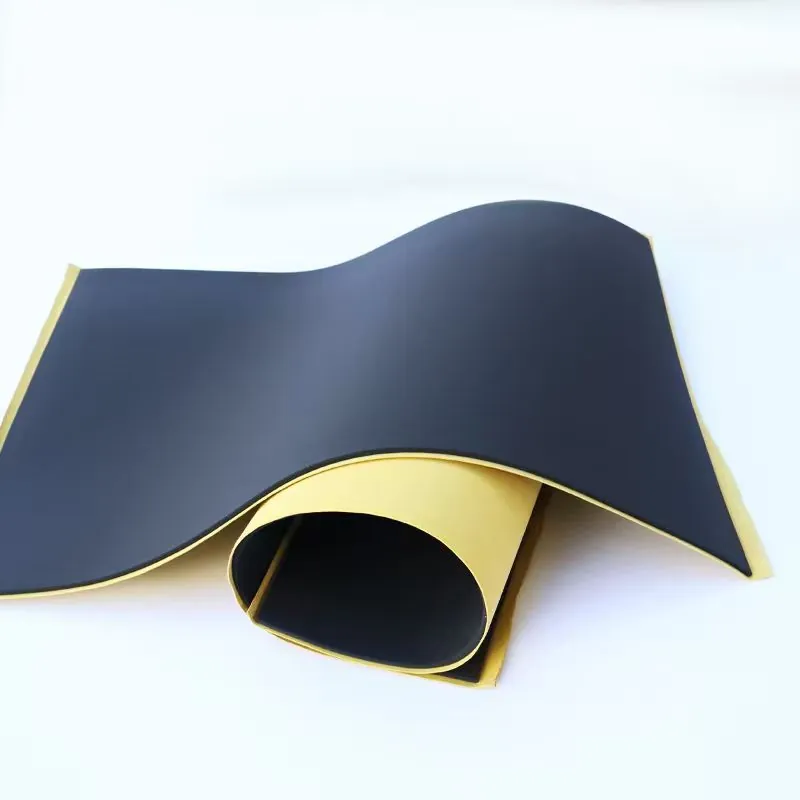
Laser Rubber Hardness: What Shore A Means for Your Dies
Ask three stamp makers about rubber hardness and you will get three confident answers — usually because each one dialed in their process on one material and never looked back. Hardness matters, but it is one variable in a system. This guide explains what Shore A hardness actually changes in a laser-engraved stamp die, how to choose a sensible starting point, and how to test properly. We manufacture laser rubber sheets and engrave dies from the same material every day, so this is workshop knowledge, not theory.
What Shore A Hardness Measures
Shore A is the standard durometer scale for rubbers: a spring-loaded indenter presses into the surface, and the resistance reads as a number from very soft (around 30) to very hard (80+). For stamp dies, hardness controls two things: how much the die face flexes when the stamp presses paper, and how the engraved relief holds its shape over thousands of impressions. It does not measure engraving quality — that comes from the compound formulation and surface uniformity.
What Hardness Changes in Practice
| Property | Softer Sheet | Harder Sheet |
|---|---|---|
| Stamping pressure needed | Less — conforms to paper easily | More — needs firm, even pressure |
| Fine text under pressure | Can squash and thicken if too soft | Holds shape, but edges print lighter |
| Self-inking mechanism fit | Good for light mechanisms within range | Risk of pale impressions in light mechanisms |
| Laser settings | Slightly less power / faster speed | Slightly more power / slower speed |
| Die durability | Flexes more per impression | More resistant to deformation |
The Practical Answer: Medium, Matched to the Mechanism
For self-inking stamp dies — the application most of our sheet customers serve — the industry standard is a medium-hardness compound. Self-inking mechanisms deliver quick, light strokes, so the die must print fully without heavy hand pressure, yet keep small characters crisp. Our A4 2.3 mm sheet is formulated squarely for this use: it is the same material we engrave for the dies inside our own self-inking stamps, which is the strongest hardness validation we can offer — millions of impressions across our export markets.
When to Consider Softer or Harder
Deviations from medium make sense in specific cases. Softer stock can help when end users stamp on slightly uneven surfaces, or with very light-duty mechanisms. Harder stock suits large solid-area dies that see heavy daily volume, where resisting deformation matters more than low stamping pressure. If your application is unusual — heavy industrial marking, specialty inks, oversized dies — tell us the use case when you inquire; material behavior under specialty conditions is something we test in-house.
How to Test Hardness Before You Commit
You do not need a durometer to evaluate a sheet. Engrave a test plate with fine text and a solid block, mount it in your actual mechanism, and stamp fifty impressions on your usual paper. Look for: full ink transfer on the first impression, no thickening of small characters by impression fifty, and crisp edges after washing. That protocol tells you more than any spec sheet number. Our sample sheets ship within 2 working days — see the product page for specs and MOQ, and the CO2 buyer guide for the full quality checklist. For a material comparison, see laser rubber vs silicone.